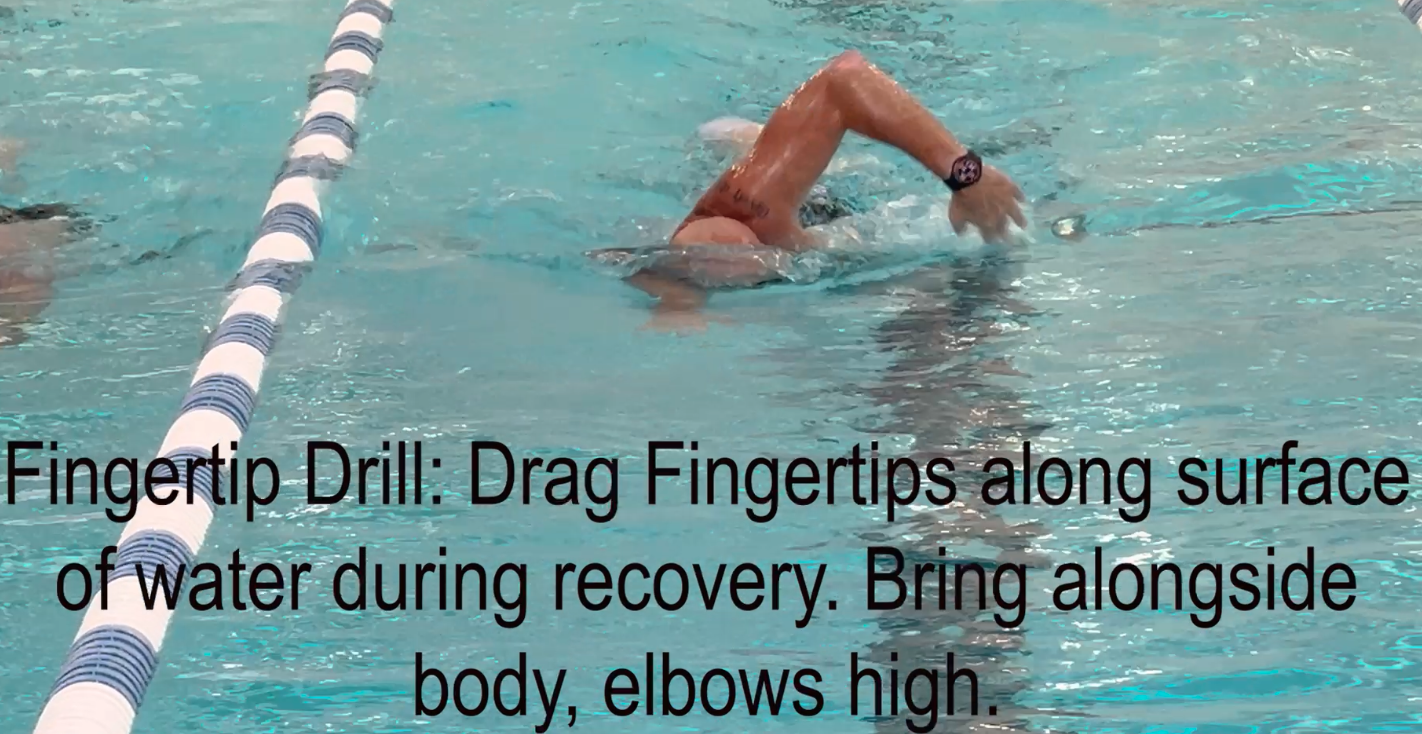
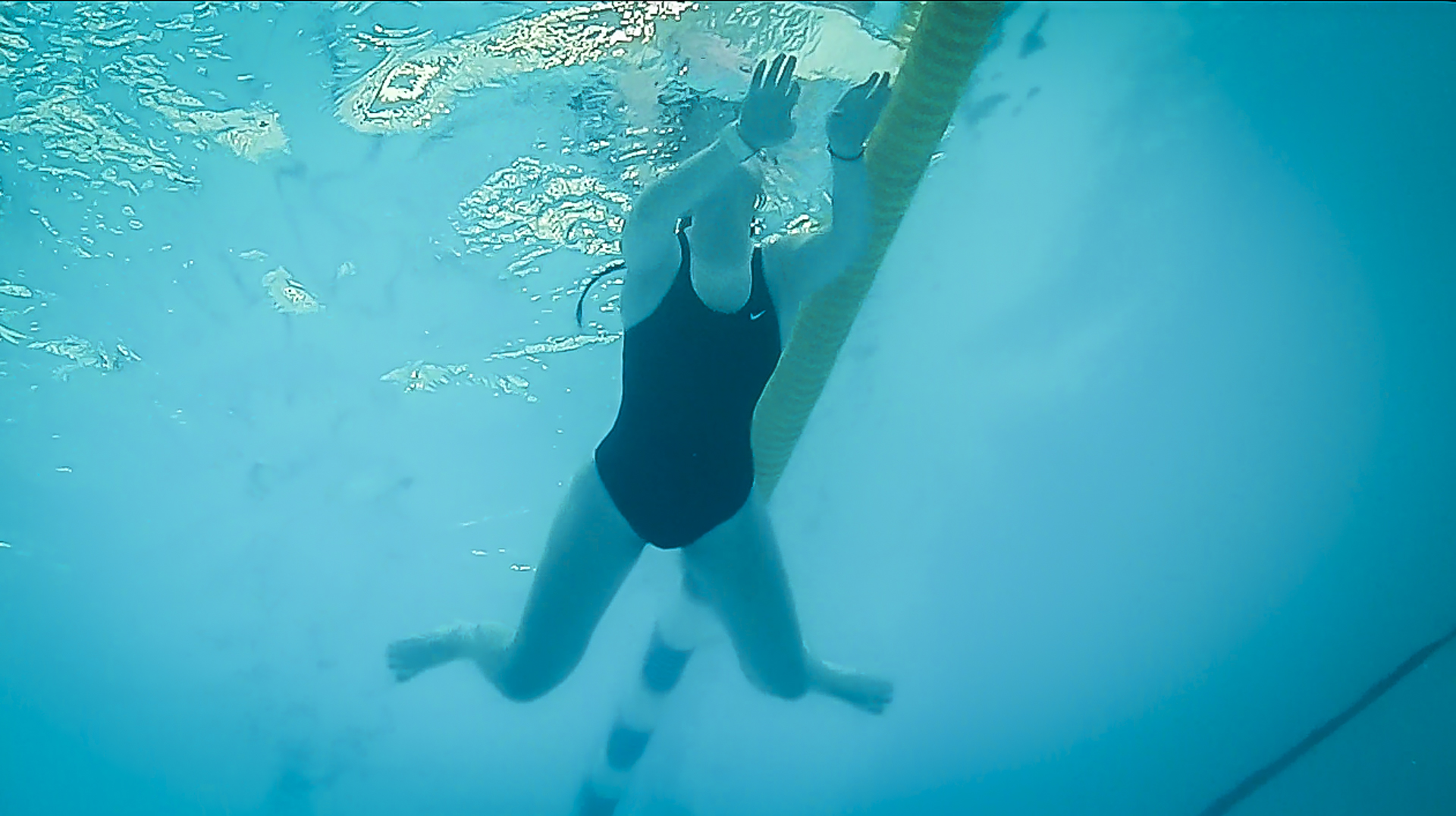
I've been swimming ever since I can remember. I took lessons from the time I put my toe in the water. Swam competitively in high school, took a few years off and from about the age 28 or so have been on average about 6 months out of 12. In the last couple of years my schedule has allowed me to be more consistent and thus I have been doing more research to try to improve my stroke. For 30 years or so I would do 40 lengths or so and sometime squeeze it up to 60. Now 60 (a kilometer and a half - about a mile) is my minimum.
I've read a number of books over the last year or so and watched dozens of videos on YouTube and other places. I had a fairly good stroke, smooth and all but I wanted to reduce my number of strokes per length and generally make my freestyle more efficient. I'm of the philosophy that one has to duplicate something to understand it before one can have judgement. Actually, this sounds pretty logical but most don't really get it. So, what I did was take the Total Immersion technique and just robotically went about learning it. Once I had it and understood how my body moved through the water using this system, I was able to take what I needed and make it work for me and what I wanted to achieve with my swimming.
As I mentioned there are numerous videos on Total Immersion Swimming - I did also get a copy of the book on the subject by Terry Laughlin which has a lot more useful information and more depth that one would get in a video.
Another book that I have found very useful is called 'Shape Up!' by Blythe Lucero. Excellent information and great workouts. She has written several books but this was the one that I found the best for my level of swimming. It has a lot of great drills that are part of the workouts. I find that if I actually do them it improves my stroke. This, along with other aspects of learning some new techniques at my age was a bit tough at first as I often tend to think I already know things and that is a definite barrier to learning. I'm read some other books - some good some bad.
One of the thing that I have found most important in training is to really take gradients. Especially at my age. When I first increased the length of my workouts I did too much too quickly and overworked my shoulders. I had to take a break. I took it back and increase very gradually. Also, pretty much every book and blog recommends recovery time. This goes for any sport and for me 3-4 times a week is plenty and gives my shoulders a rest. I sometimes would love to do more and if I really feel the need, I go and do a few miles on the bicycle.
I have also searched out some different blogs, by no means, I'm sure, all of the good ones. Some just have some good workouts and some websites have lots of marvelous, useful stroke information as well as good workouts.
For me the book Total Immersion was quite useful. It got me thinking about my freestyle and although I had a pretty smooth stroke, with this I was able to lengthen it and adjust a few things that made my stroke a whole lot more efficient.
There are a couple of different philosophies regarding what the 'best' stroke is. I try to take what works for me. For example I learned the 'Total Immersion' technique so that I knew how it felt. I'm better at distance swimming and this worked for me. Even then, once I had learned the techniques for freestyle from this Total Immersion Swimming method I then took from that what worked best for me. I do find that I have a different style for sprinting as to what I use for distance. I am using about 25% fewer strokes and for 400 or 800 meters I am doing the same or better time.
Some good references:
- this is a marvelous site. Full of all kinds of information with interactive tests and an excellent forum: http://www.swimsmooth.com
The information from this site definitely helped my stroke: http://www.totalimmersion.net/. Tons of great videos here and on YouTube.
If you like to change up your workouts this blog has different swim workouts for different levels posted most days. For me this is great - keeps it interesting. If you email you can also get questions answered:
NTC: Nation Training Center - a blog kept by Sara McLarty
Everyone is different and we are all shapes and sizes. Some techniques will work better for one person than others. As I said though, if I learn a technique - really duplicate it and then understand how it works for me - then I can have some judgement. Once I have learned that technique fully I can then take what works best for me and apply.
The websites for Canada Master Swimming and USA Masters Swimming also have a lot of useful information including times so that one can compare how they are doing to other master swimmers.
Tuesday, December 20, 2011
I love the blues
ronnie earl, ray bonneville, jj cale, chris rea, eric clapton, koko taylor, canned heat, joan armatrading, tab benoit, buddy guy, allman brothers, abert collins, angela strehli, janiva magness, roxanne potvin, bb king, big joe turner, bob dylan, van morrison, junior wells, mofro, john fahey, ella fitzgerald, billie holiday, elmore james, phoebe snow, rolling stones, etta james, fats waller, gary buford, bonnie raitt, james belushi, keb mo', john mayall, larry mccoy, luther allison, mighty blues kings, otis rush, ry cooder, susan tedeschi, taj mahal, stevie ray vaghn, robert cray
to name but just a few
Tuesday, December 13, 2011
Romanian Photographer - Mihai Ciama
A friend of mine told me about a friend of his in Romania - a photographer. He is marvelous:
Mihai Ciama
Mihai Ciama
Check out his photos when you have a moment.
Monday, November 14, 2011
Press pot coffee
We use a press pot to make our coffee. When I make it - well, it is not nearly as good. I went to this site: Coffee Geek and checked out a section on how to use a press pot and discovered what I was doing wrong. That was good but the site is great! If you like coffee or would at least like to do a better job of brewing it no matter how you make it, there are great tips here for learning those little bits that make a difference.
Friday, November 11, 2011
Toronto Brickworks - Evergreen Brickworks
Twenty-five years ago, I was a brick layer in Toronto. We used to purchase a lot of brick from the brickyard on Bayview Ave in the Don Valley. It was called Toronto Brick at the time. So, for me it was a treat recently to back and see what has been done with the place. It was closed years ago and for a long time just sat there. I'm not sure who decided to do something with this but I like what they have done with it. There are all the kilns that I never really saw way back when. They have left these pretty much as they were.
There is a very nice restaurant and a shop there that we saw. We were there on a rainy day in the fall so it was kind of dreary but I love the chance to walk about.
The picture here is of a steel piece of art representing Toronto with the rivers coming through it into Lake Ontario with plants behind the metal growing through to show the parks along the rivers - very cool.
There is a lot more information at Evergreen Brickworks(Toronto Brick) as to what is going on and the activities.
There is a very nice restaurant and a shop there that we saw. We were there on a rainy day in the fall so it was kind of dreary but I love the chance to walk about.
The picture here is of a steel piece of art representing Toronto with the rivers coming through it into Lake Ontario with plants behind the metal growing through to show the parks along the rivers - very cool.
There is a lot more information at Evergreen Brickworks(Toronto Brick) as to what is going on and the activities.
Labels:
bricklayer,
evergreen brickworks,
fall,
toronto,
toronto brick
Wednesday, November 2, 2011
How long should you keep your mattress?
Maximum - ten years or so. Lots of factors will go into this. One is the quality of mattress you purchase in the first place and the type. A water bed will likely last longer. A regular 'spring' mattress, I figure, maximum ten years. Now this will be affected also by who is sleeping on it as well. If you have someone 300 pounds it likely won't last as long as a child of 50 pounds.
Also, certain types of mattress are more prone to having dust mites as well as certain climates. I would probably tend to recycle a mattress that was in Florida more often than one in a dry climate, all other things being equal.
I travel a lot and stay in various hotels and also people's homes. Some of those mattresses are OLD. To me it is totally worth it to spend the money on a decent mattress. If I sleep well, I'm more efficient, get more done, etc. A good sleep is worth a lot.
When you shop for a mattress next time, try out a number of different kinds. Air bed, Tempur-pedic, pillow top - see what is comfortable and don't go for the cheapest.
Also, certain types of mattress are more prone to having dust mites as well as certain climates. I would probably tend to recycle a mattress that was in Florida more often than one in a dry climate, all other things being equal.
I travel a lot and stay in various hotels and also people's homes. Some of those mattresses are OLD. To me it is totally worth it to spend the money on a decent mattress. If I sleep well, I'm more efficient, get more done, etc. A good sleep is worth a lot.
When you shop for a mattress next time, try out a number of different kinds. Air bed, Tempur-pedic, pillow top - see what is comfortable and don't go for the cheapest.
Thursday, October 20, 2011
Egyptian 'cotton' sheets
I have attended a LOT of trade shows and I have been watching people purchase thousands of the inexpensive sheet sets that were originally touted as Egyptian cotton. Most places you go now will no longer have the word 'cotton' in their promotion or on their banners. This is because the products were never cotton and regulatory boards in different areas forced most people to be a little more honest. Any of these sheets that I have found are 100% synthetic.
I cringe every time I see someone carrying these cheap sheets around at trade shows!
The best thing for sleeping is to use cotton sheets. There is a great article/video here by Dr Mercola that tells you why this is so. Dr Mercola about bedding.
Synthetic sheets are less expensive but you will pay for it in less restful sleep. He likes wool as a filling - personally, I prefer silk. Silk is lighter and I find cooler in the summer and warmer in the winter and is lighter. And dust mites and other insects will not pass through it.
I cringe every time I see someone carrying these cheap sheets around at trade shows!
The best thing for sleeping is to use cotton sheets. There is a great article/video here by Dr Mercola that tells you why this is so. Dr Mercola about bedding.
Synthetic sheets are less expensive but you will pay for it in less restful sleep. He likes wool as a filling - personally, I prefer silk. Silk is lighter and I find cooler in the summer and warmer in the winter and is lighter. And dust mites and other insects will not pass through it.
Subscribe to:
Posts (Atom)